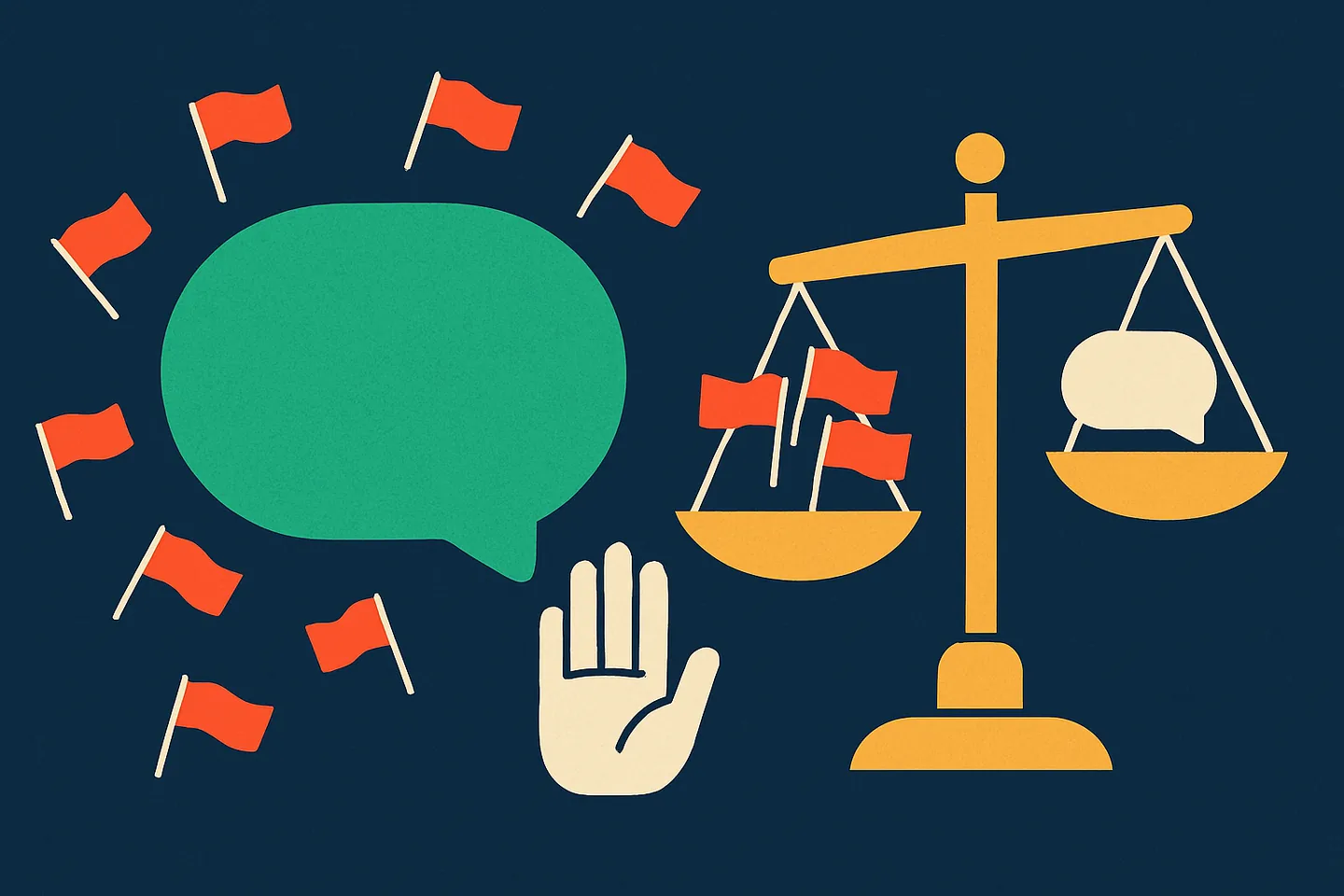
"This account cannot use WhatsApp due to spam" is the sentence thousands of business owners have photographed and posted to forums, usually with the same question underneath: I never sent spam, so why? The answer is that WhatsApp’s definition of spam has almost nothing to do with what you wrote. It is built from how you sent, to whom, and what they did next.
This guide explains what spam means to a system that cannot read your messages, the prompt WhatsApp shows every stranger you write to, how reports and blocks are weighted by relationship, the signs that you are being reported, what the current ban wording means, and how to bring the score back down.
What spam means to a system that cannot read your messages
WhatsApp messages are end-to-end encrypted, and WhatsApp says what that implies in its "Stopping Abuse" white paper: "WhatsApp cannot see the content of messages passing through our system, though we are able to analyze the frequency of account activity." It adds that "given the nature of end-to-end encryption, we focus on the behavior of accounts and user-reported content".
So spam, to WhatsApp, is a shape rather than a text. The shape is described in its own words: an account that "registered five minutes before attempting to send 100 messages in 15 seconds", one that "continually sends messages without triggering the typing indicator", one that messages "dozens of recipients who do not have the sender’s account in their contacts", one that tries "to quickly create dozens of groups or add thousands of users". The Help Center lists the everyday versions: "automated or bulk messages", "over-using broadcast lists", "using contact lists that aren’t yours", and "unwanted messages" after someone asked you to stop.
The second half of the definition is what recipients do: a message becomes spam when the people who receive it tap report or block, and WhatsApp bans "accounts that are reported multiple times". But over 75% of the accounts it bans for bulk or automated behaviour had no recent user report, so behaviour alone is enough. Reports just make it faster.
Notice what is missing: your offer, your wording, your industry. A discount code sent to 30 regulars who asked for it is not spam. The same code sent to 3,000 numbers from a spreadsheet is, whatever it says.
The prompt every unknown sender triggers
This is the mechanism most business owners have never seen from the other side. The white paper: "Whenever a user receives a message for the first time from an unknown number, we immediately display options that enable them to report or block the sender’s account." Every first message to someone who has not saved you arrives with the report button already on screen, above your text. People who manage large numbers of business WhatsApp numbers put it bluntly: the first thing a first-time recipient sees is a prominent Block button. Their estimate is that 5 to 10 complaints from first-time recipients are commonly enough to get a number blocked; an industry estimate, not a WhatsApp figure, but the order of magnitude to plan around.
That changes the arithmetic of a cold campaign. You are not sending 500 messages; you are presenting 500 people with a one-tap way to tell WhatsApp you are a problem, at the exact moment they are deciding whether they know you. Someone who saved your number, or who messaged you first, never sees that prompt.
The same prompt exists for groups: when someone is added by "someone outside their contact list", WhatsApp offers report or exit. Adding people who did not ask is a report prompt sent to a room.
How reports and blocks are weighted by relationship
Reports are not counted, they are weighed. WhatsApp explains why: the reporting tool "can be manipulated", and a group of actors could "organize other users to make a series of reports against their victim". To avoid knocking innocent people off the platform, "we evaluate the relationship between the reporter and the reported user".
Then comes the sentence that matters most for anyone doing outreach: "when someone reports the first message they receive from an unknown number, we have higher confidence that the report is legitimate." In the opposite case, "when the reported number did not initiate the communication", WhatsApp works to make sure there was no coordination before it acts.
Read that as a table. A report from a stranger on your first message: heaviest. A block from a stranger: heavy, and it also means every later message to them is undelivered. A report from someone you have talked with for months: lighter, and checked. A report from someone who messaged you first: lightest of all, because you did not initiate.
That is the whole case for inbound-first marketing: the relationship in which a report counts least is the one where the customer opened the chat.
Blocks feed the same evaluation: the white paper defines negative feedback as "user reports and blocks" together. A wave of blocks after a campaign counts even if nobody presses report.
Reports as a rate, and the counter that remembers
People who run many business numbers describe the same weighting as a rate: out of every hundred people you message, how many block you. Their estimate is that fewer than 1 in 100 is the safe zone. Above about 2 in 100, they report, WhatsApp starts cutting how many people you can message in a day, and you have roughly seven days to bring the rate down before the whole number is at risk. Nothing on your screen shows this rate, which is why the signs in the next section are how you read it. These are estimates from people who run many business numbers; WhatsApp publishes none of this.
The same people report a 2026 change: WhatsApp now appears to count every message that gets no reply within 48 hours, and keeps that count over a rolling 30 days. If that is right, a quiet three weeks still weighs on today, and the fact that someone once agreed to hear from you does not cancel out that they stopped answering. Cleaning the list stops being something you do before a campaign and becomes weekly work: people who stopped replying come off the list before the next send, not after the next ban. WhatsApp has not published this; treat it as an industry observation.
Signs you are being reported
WhatsApp never tells you who reported you or how many did. What you can read are the side effects.
- Single grey ticks that never turn into two. One tick means the message reached WhatsApp but not the phone. A phone that is off does that too, but a cluster of single ticks appearing right after a campaign, on numbers that were reachable last week, is the signature of blocks.
- Silent non-delivery on broadcast lists. Broadcasts only reach people who have saved you. If a list that used to land now reaches half its recipients, some of them removed you, and removing is one step from blocking.
- Replies that are stops. "Who is this", "stop", "remove me", "how did you get my number". Each one is a person who chose to type instead of tapping report. Treat every one as a report that has not happened yet.
- A temporary ban with a countdown. This is the loudest sign. WhatsApp describes it as a warning: if the behaviour continues, "your account might be permanently banned".
There is no app, service or trick that reveals your report count. Anything that claims to is guessing from the same ticks you can see yourself, and it wants your account access to do it.
"Due to spam" vs "This phone number can’t use WhatsApp"
Older screenshots and forum posts show the sentence "This account cannot use WhatsApp due to spam". The wording WhatsApp’s Help Center documents today is different: "This phone number can’t use WhatsApp: [phone number]. You can request a review of this number. Most reviews are completed within 24 hours." The reasons are given in a single line: "We ban accounts if we believe the account activity violates our Terms of Service, for example if it involves spam, scams or if it puts WhatsApp users’ safety at risk."
Both screens mean the same thing: a ban, not a countdown. What matters is the button. If you see Request review, the ban can be appealed, one number per appeal, and you get a WhatsApp notification with the decision. If there is no review option, "it means the ban is final and can’t be appealed".
Two more facts from the same page: contacting WhatsApp "outside the review process or through another user’s account" changes nothing, and "third party services can’t ban your WhatsApp account or remove your account ban", which is the polite way of saying do not pay anyone who promises an unban.
Why "WhatsApp spam bot" tools produce exactly the shape WhatsApp hunts
The tools sold as bulk senders, auto-messagers or WhatsApp bots automate the consumer app or a WhatsApp Web tab. WhatsApp’s position is unambiguous: "Our products are not intended for bulk or automated messaging, both of which have always been a violation of our Terms of Service", and "Don’t bulk message, auto-message, or auto-dial using WhatsApp."
They also fail the behaviour test. They send at machine speed, so the rate of messaging spikes. They send identical text, so hundreds of chats receive the same message at once. They usually skip the typing indicator, which WhatsApp uses as an automation tell: "If an account continually sends messages without triggering the typing indicator, it can be a signal of abuse, and we will ban the account." And they send to lists, which means mostly to people who never saved you, each of whom gets the report prompt.
Pacing tools are not magic either. Spacing messages out, varying the gap, sending only to saved or recently active contacts and honouring stop words reduce every one of those signals. They do not change a list that does not want to hear from you, and no tool on any lane can promise immunity to a sender who spams.
How to bring the score down
- 1
Stop the campaign today
Every message to a cold contact adds a chance of a first-message report, the heaviest signal there is. Stop before you change anything else.
- 2
Remove everyone who signalled
Anyone who replied stop, asked who you are, left a group or shows a permanent single tick comes off every list, permanently. WhatsApp’s wording: "remove the contact from your address book and refrain from contacting them again."
- 3
Put the opt-out in the message
A line such as "write stop to stop receiving our messages" gives an unhappy recipient a cheaper action than the Report button; people who run many business numbers find it weeds out unhappy contacts and lifts the reply rate at the same time. Then honour it, instantly and permanently.
- 4
Shrink the audience to people who know you
Saved contacts and people you have exchanged messages with in the last 30 days. Everyone else waits until they contact you. The industry observation here is that how many different people you message matters more than how many messages you send: reaching many new contacts in a short period is what reads as spam.
- 5
Make the next message worth a reply
Ask a question, offer something specific, write like a person. A common piece of industry advice is to put a question in the first message so the recipient answers with at least something; replies are the opposite of reports, and a conversation with traffic both ways looks nothing like a spam account.
- 6
Slow the pace and keep it uneven
Seconds between messages, never the same gap, daytime only, a ceiling per hour you do not cross. If a tool sends for you, it should enforce this rather than leave it to you.
- 7
Open inbound routes
A QR code at the till, a click-to-chat link on your site, a form or a giveaway that opens a WhatsApp conversation from their side. The Help Center’s best practice: "It’s best to give contacts your phone number so they can message you first." People who run many business numbers call a conversation the customer starts the lowest-risk kind there is, and report fewer blocks for businesses built that way.
- 8
Give it time
WhatsApp does not publish how long negative feedback stays in the score. Treat the weeks after a scare as a probation you set yourself: normal two-way use, small sends to warm contacts, no bursts.
The problems behind a spam ban, and how Spun handles each one
- 1
You blasted a list and half of them had never saved you
Each of those first messages arrived with a report button, and a first-message report from a stranger is the one WhatsApp trusts most. Spun’s audience filter has a "Saved contacts only" setting and an activity filter (last 7, 30 or 90 days), and a pre-send check refuses numbers that are not on WhatsApp. The consent half is yours.
- 2
A customer said stop and got three more messages
One more message after a stop turns a mild complaint into a report, the heaviest signal there is. Spun applies the DONOTSEND label automatically when a contact writes STOP, unsubscribe or remove me in any of 11 languages, every campaign, bot and follow-up respects it, and a warning before you overlap the last seven days of sends stops the repeat happening by accident.
- 3
You send hundreds of messages and almost nobody replies
A line that only talks outward looks nothing like the one-to-one traffic WhatsApp says makes up about 90% of its messages. Spun puts every reply in a shared team inbox so someone answers it, and Keep In Touch lists the contacts you have not spoken with in 7, 30 or 90 days per label, so the number stays in two-way use. Replies still depend on sending something worth answering.
- 4
Every conversation starts from your side
A report on a first message you sent is trusted most; a report on a chat the customer opened is checked before it counts. Spun’s Lead Games spin wheel has "Require WhatsApp before spinning" on by default, so every entrant messages you first, and a QR code or click-to-chat link does the same.
- 5
Your campaign ran overnight at machine speed
Speed and regularity are scored even when nobody reports you. Spun spaces every message by a random gap inside your pace preset, the server caps the pace above that, and quiet hours pause campaigns overnight. It lowers the score; it cannot make a cold list want you.